Carbon Nanotubes Improve Protein Array Detection Limits
To detect cancer as early as possible, dozens of research groups are developing methods to detect trace levels of... (Nov. 20, 2008) [Read more]


Carbon Nanotubes Detect Lung Cancer Markers in the Breath
Using an array of nanotube devices, each coated with a different organic material, researchers at the Israel Institute of... (Nov. 20, 2008) [Read more]


Less-Invasive Brain Interfaces
Using electrocorticography (ECoG) -- recording neural activity from a sheet of electrodes laid directly on the surface of a... (Nov. 21, 2008) [Read more]


Plumbing the oceans could bring limitless clean energy
Ocean Thermal Energy Conversion (OTEC) -- which exploits the difference in temperature between seawater near the surface and... (Nov. 19, 2008) [Read more]


Cybercrime toll threatens new financial crisis
International regulation must be improved to avoid Internet crime (estimated at $100 billion annually) causing global... (Nov. 20, 2008) [Read more]


Light opens up a world of sound for the deaf
Northwestern University researchers have found that infrared light can stimulate neurons in the inner ear as precisely as sound... (Nov. 20, 2008) [Read more]


Google Personalizes Search with SearchWiki
Google has introduced a new feature called SearchWiki that will allow people (in a gradual rollout to all users) to modify and... (Nov. 20, 2008) [Read more]


Honda displays 21st-century supercar concept
At the 2008 Los Angeles Auto Show, Honda showed off a supercar concept, the FC Sport, powered by an electric motor, with energy... (Nov. 20, 2008) [Read more]


Bay Area's big-city mayors endorse $1 billion plan for electric cars
Better Place wants to build 100,000 battery-charging stations and 50 battery exchange stations in the Bay Area where drained... (Nov. 20, 2008) [Read more]


Eric Schmidt: Oil is Finite But Information Is Infinite
The Internet can help the energy crisis by creating an informed -- and action-oriented -- user base, Google CEO Eric Schmidt... (Nov. 19, 2008) [Read more]


New theory of visual computation reveals how brain makes sense of natural scenes
Computational neuroscientists at Carnegie Mellon University have developed a computational model that provides insight into the... (Nov. 19, 2008) [Read more]


Massive EU online library looks to compete with Google
The EU launches Thursday its Europeana digital library, an online digest of Europe's cultural heritage, with millions of... (Nov. 19, 2008) [Read more]


How Google's Ear Hears
The new voice-search application for the iPhone marks a milestone for spoken interfaces. Google used the huge amount of data on... (Nov. 20, 2008) [Read more]


Personalised cancer treatment on the way
University of Chicago scientists have discovered a genetic signature that predicts whether a variety of cancers will respond to... (Nov. 19, 2008) [Read more]


Mysterious electrons may be sign of dark matter
A balloon-borne detector flying over Antarctica called the Advanced Thin Ionization Calorimeter (ATIC) has detected 70 more... (Nov. 19, 2008) [Read more]


Hunting for a Brainy Computer
The Defense Advanced Research Projects Agency has awarded a $4.9 million grant to five universities and IBM Research for the... (Nov. 20, 2008) [Read more]


Regenerating a Mammoth for $10 Million
A scientific team at Pennsylvania State University has recovered a large fraction of the mammoth genome from clumps of mammoth... (Nov. 19, 2008) [Read more]


Microsoft Releases New Robot-Building Software
Microsoft has released Robotics Developer Studio 2008, a software program that enables users to create applications for robots.... (Nov. 19, 2008) [Read more]


NASA Successfully Tests First Deep Space Internet
NASA has successfully tested the first deep space communications network modeled on the Internet, using software called... (Nov. 19, 2008) [Read more]


Carbon-Nanotube Thread
University of Michigan researchers have coated conventional cotton thread with highly conductive, biosensing carbon nanotubes. ... (Nov. 19, 2008) [Read more]


Six ways to build robots that do humans no harm
The book Moral Machines: Teaching Robots Right from Wrong offers six strategies that could reduce the danger from our own... (Nov. 18, 2008) [Read more]


Quantum calibration paves way for super-secure communication
A new approach to calibrating quantum mechanical measurement has allowed scientists to calibrate a detector that can sense the... (Nov. 17, 2008) [Read more]


Prophesy of economic collapse 'coming true'
A real-world analysis of a controversial prediction made 30 years ago in the book Limits to Growth concludes that economic... (Nov. 17, 2008) [Read more]


Broken nerves can be fixed in a flash
Rats with breathing problems caused by damage to their nerves have had normal breathing restored by bursts of visible light... (Nov. 17, 2008) [Read more]


Tunnelling nanotubes: Life's secret network
Recently discovered tunneling nanotubes may be responsible for the spread of HIV and prion infectivity from cell to cell,... (Nov. 18, 2008) [Read more]


Making Graphene More Practical
Researchers at the University of California, Los Angeles, have found a simple way to make large pieces (tens of micrometers... (Nov. 18, 2008) [Read more]


Science's Alternative to an Intelligent Creator: the Multiverse Theory
The multiverse may well be the only viable non­religious explanation for what is often called the "fine-tuning problem"... (Nov. 10, 2008) [Read more]


I-Ball technology to give troops eye on the ground
The I-Ball, a portable, wireless, projectile camera from Scotland-based Dreampact using real-time video with a 360-degree view,... (Nov. 17, 2008) [Read more]


Two supercomputers now exceed petaflop/s barrier
IBM's Roadrunner, a 1.105 petaflop/s supercomputer at Los Alamos National Laboratory, retained the top spot as the world's... (Nov. 18, 2008) [Read more]


Billions of particles of anti-matter created in laboratory
Lawrence Livermore National Labs scientists have created the largest number yet of anti-matter positrons (anti-electrons),... (Nov. 18, 2008) [Read more]


Micro Fuel Cells Get Closer to Replacing Batteries
Researchers at at the Institute of Electronics, Microelectronics and Nanotechnology (IEMN) in France and Sharp Corporation... (Nov. 17, 2008) [Read more]


Opening announced for Research Fellow in Future Studies
The Oxford-based James Martin Institute has announced an opening for a post as a Research Fellow in Future Studies for someone... (Nov. 17, 2008) [Read more]


Norvig, Omohundro, Goertzel and Pell Say How They'd Advise Obama's if Appointed U.S. CTO
Invest a half-trillion dollars in R&D in AI and other areas, instead of a bailout, AI panel members at Convergence08 advised... (Nov. 15, 2008) [Read more]


A Computing Pioneer Has a New Idea
The Convey supercomputer, to be introduced this week, promises to be simpler to program, using Intel-based field programmable... (Nov. 16, 2008) [Read more]


How to embed photos and videos in your video
Stanford University AI researchers have developed software that allows anyone to insert a video or still photo on almost any... (Nov. 17, 2008) [Read more]


[Click here to check out all News items]


Openness and the Metaverse Singularity
By Jamais Cascio
The four worlds of the Metaverse Roadmap could also represent four pathways to a Singularity. But they also represent potential dangers. An "open-access Singularity" may be the answer. The people who ... (November 7th 2007)

What If the Singularity Does NOT Happen?
By Vernor Vinge
It's 2045 and nerds in old-folks homes are wandering around, scratching their heads, and asking plaintively, "But ... but, where's the Singularity?" Science fiction writer Vernor Vinge--who originated... (March 14th 2007)

Foreword to The Intelligent Universe
By Ray Kurzweil
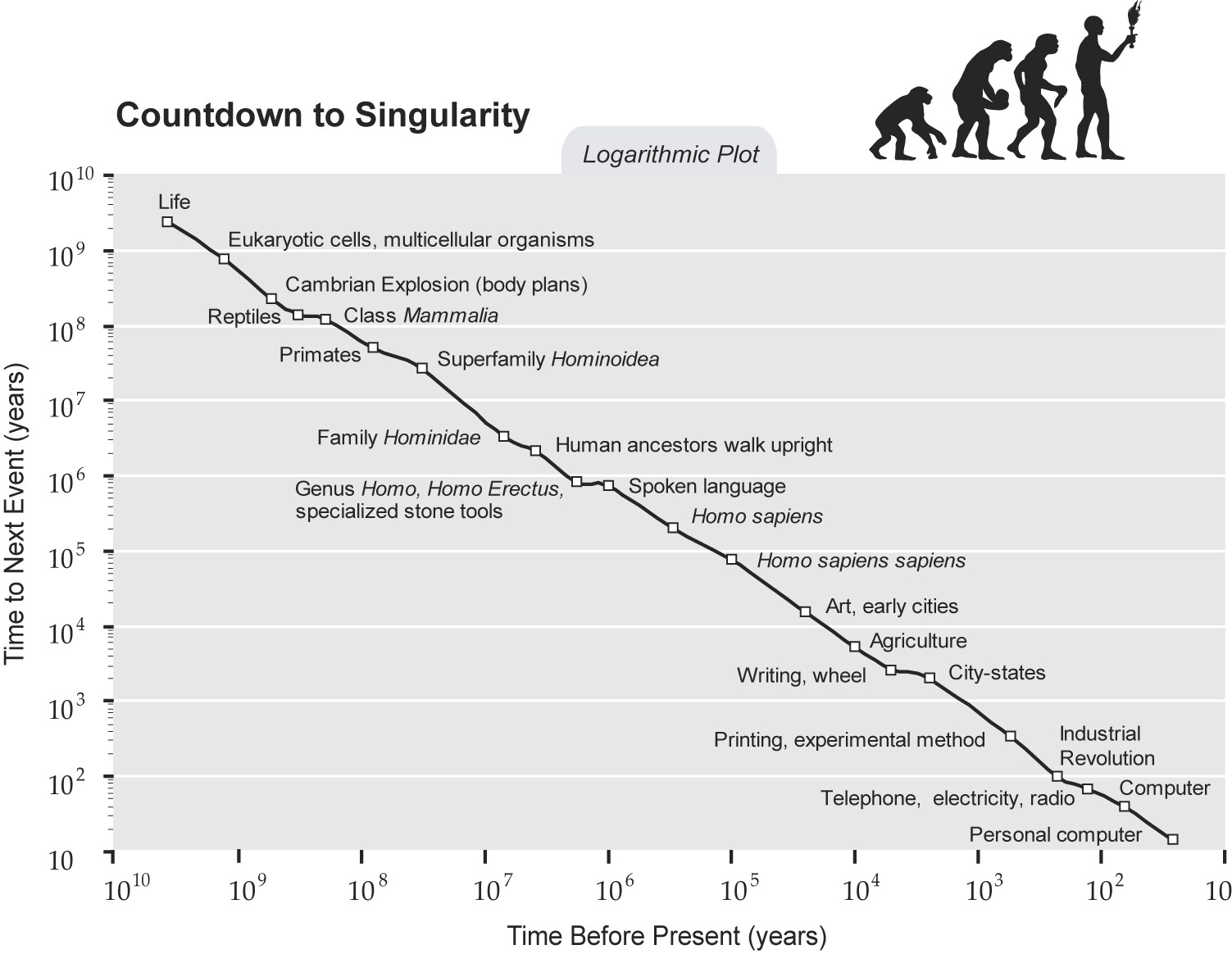
The explosive nature of exponential growth means it may only take a quarter of a millennium to go from sending messages on horseback to saturating the matter and energy in our solar system with sublim... (February 2nd 2007)

[Click here to check out all The Singularity articles]


BREAKPOINT: terrorists vs. transhumanists
By Richard A. Clarke
Former counterterrorism czar Richard Clarke’s BREAKPOINT novel, set in the year 2012, is based on emerging technologies. "Globegrid," a high-speed global network, links supercomputers worldwide. Combi... (May 18th 2007)

Space Wars: The First Six Hours of World War III
By William B. Scott
Space Wars by Willliam Scott, Michael Coumatos, and William Birnes, Forge Books (April 17, 2007) describes how the first hours of World War III might play out in the year 2010. While fiction, it's bas... (April 17th 2007)

The Moon as backup drive for civilization
By KurzweilAI.net
Imaginative new ideas for using space to protect civilization against existential risks, such as killer asteroids, nuclear war, and global terrorism, are in the works. The public increasingly sees NAS... (September 24th 2006)

[Click here to check out all Dangerous Futures articles]


Why Language Is All Thumbs
By Chip Walter
Toolmaking not only resulted in tools, but also the reconfiguration of our brains so they comprehended the world on the same terms as our toolmaking hands interacted with it. With mirror neurons, some... (March 15th 2008)

AI Meets the Metaverse: Teachable AI Agents Living in Virtual Worlds
By Ben Goertzel
Online virtual worlds have the power to accelerate and catalyze the development of artificial general intelligence (AGI). As AGIs involved in this metaverse become progressively more intelligent from ... (October 18th 2007)

The Age of Virtuous Machines
By J. Storrs Hall
In the "hard takeoff" scenario, a psychopathic AI suddenly emerges at a superhuman level, achieving universal dominance. Hall suggests an alternative: we've gotten better because we've become smarter,... (June 1st 2007)

[Click here to check out all How to Build a Brain articles]


Gelernter, Kurzweil debate machine consciousness
By Rodney Brooks, Ray Kurzweil, and David Gelernter
Are we limited to building super-intelligent robotic "zombies" or will it be possible and desirable for us to build conscious, creative, volitional, perhaps even "spiritual" machines? David Gelernter ... (December 6th 2006)

Cyber Sapiens
By Chip Walter
...We will no longer be Homo sapiens, but Cyber sapiens--a creature part digital and part biological that will have placed more distance between its DNA and the destinies they force upon us than any o... (October 26th 2006)

Why We Can Be Confident of Turing Test Capability Within a Quarter Century
By Ray Kurzweil
The advent of strong AI (exceeding human intelligence) is the most important transformation this century will see, and it will happen within 25 years, says Ray Kurzweil, who will present this paper at... (July 13th 2006)

[Click here to check out all Will Machines Become Conscious? articles]


Bootstrapping our way to an ageless future
By Aubrey de Grey
Biomedical gerontologist Aubrey de Grey expects many people alive today to live to 1000 years of age and to avoid age-related health problems even at that age. In this excerpt from his just-published,... (September 19th 2007)

Press ignores bias in study of multivitamins and prostate cancer
By Ray Kurzweil and Terry Grossman
In a recent paper reporting on the National Cancer Institute study of multivitamin use and the risk of prostate cancer, the NCI authors cited several possible bias factors. An analysis by Ray Kurzweil... (May 25th 2007)

Strategic Sustainable Brain
By Natasha Vita-More
The human brain faces a challenging future. To cope with accelerating nanotech- and biotech-based developments in an increasingly complex world, compete with emerging superintelligence, and maintain i... (March 31st 2006)

[Click here to check out all Living Forever articles]


How to Build a Virtual Human
By Peter Plantec
Virtual Humans is the first book with instructions on designing a "V-human," or synthetic person. Using the programs on the included CD, you can create animated computer characters who can speak, dial... (October 20th 2003)

Remarks about Tod Machover In Presenting the 2003 Ray Kurzweil Award of Technology in Music
By Ray Kurzweil
Ray Kurzweil presented the 2003 Ray Kurzweil Award of Technology in Music to Tod Machover at the Fourth Annual Telluride Tech Festival (August 8-10, 2003). The award was in recognition of Machover's p... (August 11th 2003)

Glitches Reloaded
By Peter B. Lloyd
In Matrix Reloaded, how can Neo fly and use telekinesis if the Matrix is supposed to a physics simulation? Peter Lloyd decodes this and other technical enigmas--reverse-engineering the design of the M... (June 2nd 2003)

[Click here to check out all Virtual Realities articles]


Who Will Rule the 21st Century?
By Jack Welch
Straight-line extrapolation shows that China and India, with their faster growth rates, will eventually catch up to the U.S. in terms of pure economic size. But America has a final competitive advanta... (May 25th 2008)

EGOGRAM 2007
By Sir Arthur C. Clarke
The Golden Age of space travel is still ahead of us. Over the next 50 years, thousands of people will gain access to the orbital realm -- and then, to the Moon and beyond, says Sir Arthur, 89.... (February 7th 2007)

I'm Confident About Energy, the Environment, Longevity, and Wealth; I'm Optimistic (But Not Necessarily Confident) Of the Avoidance Of Existential Downsides; And I'm Hopeful (But Not Necessarily Optimistic) About a Repeat Of 9-11 (Or Worse)
By Ray Kurzweil
Ray Kurzweil responds to John Brockman's The Edge Annual Question - 2007: WHAT ARE YOU OPTIMISTIC ABOUT? WHY? ... (February 4th 2007)

[Click here to check out all Visions of the Future articles]


Response to 'The Singularity Is Always Near'
By Ray Kurzweil
In "The Singularity Is Always Near," an essay in The Technium, an online "book in progress," author Kevin Kelly critiques arguments on exponential growth made in Ray Kurzweil's book, The Singularity I... (May 4th 2006)

Wolfram and Kurzweil Roundtable Discussion
By Ray Kurzweil and Stephen Wolfram
"The most dramatic possibility is the universe started from a simple initial condition that had some simple geometrical symmetry. It might be the case that if we turn our telescope off to the west, an... (February 24th 2006)

Ray Kurzweil Responds to Richard Eckersley
By Ray Kurzweil
"Eckersley bases his romanticized idea of ancient life on communication and the relationships fostered by communication. But much of modern technology is directed at just this basic human need."... (February 3rd 2006)

[Click here to check out all Point/Counterpoint articles]


Engines of Creation 2.0: Molecular Engineering: An Approach to the Development of General Capabilities for Molecular Manipulation
By K. Eric Drexler
Developing the ability to design protein molecules will make it possible to construct molecular machines. These can then build second-generation machines that can perform extremely general synthesis o... (March 20th 2007)

Engines of Creation 2.0: Advice To Aspiring Nanotechnologists
By K. Eric Drexler
It makes no practical sense to try to build a molecular assembler today. But we can build enabling technologies today, including protein engineering, general macromolecular engineering, and micromanip... (March 15th 2007)

Engines of Creation 2.0: Letter From Author
By K. Eric Drexler
Engines of Creation in 1986 inspired an explosion of interest in nanotechnology. Version 2.0 updates this classic book, including new concepts for molecular manufacturing and new uses for nanotech, s... (March 15th 2007)

[Click here to check out all Nanotechnology articles]